Jamia ka Tarana
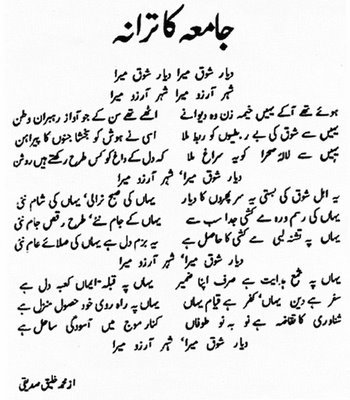
Oct 17, 2007
Jamia Middle School...Art Teacher (hafizuddin Sahib)
Some teachers teach you mathematics. Some teach you science and some teach you the art of keeping quiet.
Hafizuddin Sahib belonged to the third category.
He was our art teacher in Jamia Middle School, and while most of us never learned to draw, we all learned to fear one phrase.
"Ek, Do, Teen (One, two, three), Khamosh!! (Quiet)"
This was a normal hearing during art class conducted by Hafeezuddin Sahib to keep the students quiet during Art period in Jamia Middle School.
It was not a request.
It was not a suggestion.
It was a warning.
The countdown before the storm!
Very tall, thin and slightly dark complexion man with conical shape beard, white skull cap (topi) and wasket of Khadi Gram Udyog.
With this attire and a different attitude, Hafiz Sahib was altogether carrying a different persona in school.
He looked like a man who had walked out of a different era, a different world, where art was serious business and students were meant to be seen and not heard.
I don't remember exactly, but in nutshell he tried his level best to teach us art and many of us turned to be a big zero in arts including myself.
The funniest thing we learned was his style to make the class quiet. Ek, Do, Teen was always an alarm to sealed the lips. But it was not an alarm that worked immediately. It was an alarm that had to be repeated. Again and again. Until the noise died. Until the chatter stopped. Until the class finally understood that playtime was over.
As a steroid, he used to keep one stick always with him. In first attempt nobody cares to listen Ek, Do, Teen, until he repeat it three to four times before punishing the rest with the stick. Once he succeeds in keeping the pupil of first rows he moves to last rows allowing the first rows to start chatting again. Therefore, stick was always an effective and last resort. The stick was not just a tool. It was his third hand. His constant companion. His only ally in a classroom full of boys who would rather talk than draw.
"Keep your drawing notebook, HB, HB1, B1 pencil, eraser, sharpener, water paints on the desk!"
None of students ever has all the accessories available with them. After all these repeated frustrating non-cooperation from students, Hafizuddin Sahib used to remain determined towards his teaching. He would look at the empty desks, the missing pencils, the forgotten notebooks, and still,
he would teach.
Still, he would try.
Still, he would believe.
He then used to move on black board with chalk and a duster in hands. I never witnessed that he ever progressed more than three to four themes during my entire art classes. Every grade we move, he updates the same models and asked us to generate the same with a clear-cut understanding that we will never going to make up.
He was right.
I never generated more than three themes!
Two cubes!
Two cubes with a utensil!
Human face outline!
Scenery,
Now the last option always comes when he left the choice on students with a topic to draw "Man pasand" (your choice).
It was the best option for many of us. We never hesitate to draw a mountain, setting sun, a river coming down having a hut on the bank of it, a boat, and lot of grass, a palm tree and outline of many birds returning home. It was the same drawing every time. The same mountain. The same sun. The same hut. The same boat. The same birds.
Maybe 100 times we drew it.
And maybe 100 times, Hafiz Sahib checked it without complaint.
Hafizuddin Sahib was patient enough to check all those repeated drawings with his remarks. During teaching and practicing, he taught us to adjudge the things in real and transform them on paper proportionately. Unfortunately, I never understood this funda despite of his grave efforts.
I could see the mountain.
I could see the sun.
But I could never see what he wanted me to see.
The proportion!
The perspective!
The art!
Sometimes he beats the arrogant and dumb art students like me with duster, which in fact was painful. The duster would land on our heads, on our shoulders, on our palms. It was not violence.
It was frustration.
The frustration of a teacher who knew his subject but could not make his students see it.
Girls were little sensible in their approach.
Although they all were not very good in drawing but their works were neat, tidy and clean all the times that fetched them high marks. They understood something we boys never did.
Art was not about talent.
It was about effort.
About neatness.
About respecting the paper you were given.
Hafiz Sahib was having a nick name given by Unknown but inherited to us by our seniors. "Chuggi Balla."
I never understand the full meaning of it.
However, it was really funny at that age to repeat this nick among friends.
Maybe due to his height and type of beard someone has given this name.
We would whisper it in corridors, laugh in corners, and feel like rebels for saying two words that meant nothing and everything.
Although I know this is bad to give nicks to teachers but during school days, it was a normal practice and the one among few entertainments. If I regret at this age of that kind of attitude, then I will be denying a full student life. However, it can always be forgiven on the basis of childhood.
We were not cruel.
We were just children.
Children who did not know better.
Children who laughed at things they did not understand.
Hafiz Sahib was the most wanted and busiest person during one day's school and Talimi Mela later.
All the artworks, cutouts were under his supervision and students took benefits by working under his guidance.
But there were few who slipped to his camp during those days just to grab a token in favor of canteen to grab tea and samosas.
They would volunteer to help with the decorations, hold the scissors, paste the paper, and then disappear towards the canteen with their reward.
According to Hafiz Sahib everything was an art.
Therefore, few consider cheating him for the sake of samosa and tea as an ART!
I was among those who believe in Samosa and tea at that time back in 1980's.
I was not an artist then.
I was not a painter.
But I was a boy who loved samosas and understood that art could be found in many forms. Even in the art of getting a free snack.


Subscribe to:
Post Comments (Atom)
Its nice to have a random glance on the diary written and I appreciate that you have a feelings and stampred memories of Jamia.
ReplyDeleteI would like to say this also. That keepig such type of records and memories is very difficult work. you are like a rope on Well Boundary, which leaves its impression on stone, which possible only with consistancy and patience. You are a mile stone.
Regards
Intakhab Ur Rehman Khan
0501640392