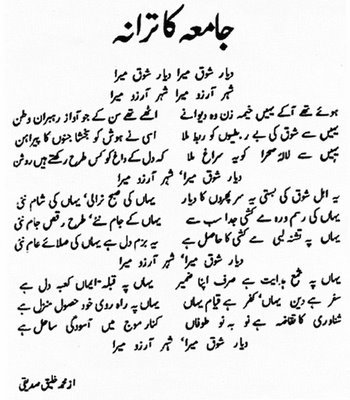
Jamia ka Tarana
Oct 31, 2007
Memory lane...JMI, Ansari Health Centre
The Doctor Who Thought She Was Indira Gandhi
Some places you avoid because they are dangerous. Some you avoid because they are unpleasant. And some you avoid because they make you feel small, powerless, invisible. For many of us at Jamia Millia Islamia during the 1980s, that place was the Ansari Health Centre, and the person who made it feel that way was Dr. Asma.
Ansari Health Centre is of course very established and advanced nowadays, but it was small with limited people during our days. The main people at the dispensary were Jafar Bhai (late), Sadaqat Bhai, and Dr. Asma. The worse part of the dispensary was Dr. Asma. The best was Jafar Bhai and Sadaqat Bhai. Two men who healed with their hands and their hearts. One woman who wounded with her indifference.
Looking at the perspective of just a student with no great reference will put more light to my comment about Dr. Asma. She never considered herself lesser than Indira Gandhi, PM of India. In her mind, she was not a doctor serving a university. She was a queen ruling a kingdom. And we, the students, were merely subjects who had to wait for her grace. Whenever you go to her, for cough, fever, cold, or pain, she always keeps you waiting for a long time. The chairs outside her cabin were not seats of comfort. They were seats of humiliation. She gives preference to top grade people of JMI, like professors, readers, and then teachers. No matter how long the queue is, they always get instant entry upon arrival. You could be sitting there for an hour, fever burning your forehead, cough tearing your chest, and then a professor would walk in, and the door would open for him like magic. Sometimes, even other employees of Jamia get frustrated by this, but what to do? She was the only doctor available. Therefore, live or leave, it is all up to you.
During checkup, she seldom put stethoscope and rarely touches you to examine anything. Your checkup is over without even looking at you and your prescription always remains self-explanatory of the discrimination in AHC by Dr. Asma. You always end up with diluted syrup from one gallon bottle with loose tablets of Vitamin C, yellow color B Complex, aspirin or paracetamol, and sometimes phenyl butazone. Those loose tablets in paper folds were not medicine. They were reminders. Reminders that you were not important. In contrary, any professor and top-grade employee or even acquaintance of Dr. Asma goes with fresh packed bottle and strips of tablets. The same dispensary. The same medicines. But two different worlds.
Those were the issues, really annoyed many of us during those days. That's how I never got well even a single time by her prescription. Maybe the medicine was fine. Maybe it was the diagnosis that was missing. Or maybe, it was the dignity that was never prescribed.
However, if you go to the dressing lab, the whole dispensary looks totally different. It was a different world altogether. A world where Jafar Bhai and Sadaqat Bhai ruled, and where even pain was treated with care.
Jafar Bhai. He was an old man with black and white moustaches and an old fashion vision glasses. His smile was very bad and students always afraid to go to him. He always has either red or blue lotion for your injury and belladonna tape for boils. The problem was not with lotion or tape. The actual problem was his talking and handling your injury. The way he talks made you half-finished and balance after you come out of lab. You would walk in with a small cut and walk out feeling like you survived a battle. Despite all, nobody hated him ever. Yet, we don't like him but always respected him because he knows parents of every day scholar and warden of each hosteler. He knew us not as files or numbers, but as sons and daughters of people he knew. He is no more in this world now, but whenever I think of dispensary, I can't forget his eyes and smile.
Sadaqat Bhai, an opposite equal of Jafar Bhai. Sadaqat Bhai was hot favorite. He was young compared to Jafar Bhai and was very quiet and calm person. Always listen and try to understand your problem. He also uses the same medicine but with a difference. People get little pain while handled by him rather than Jafar Bhai. His practical jokes of Jamia staff were also liked by many. With Sadaqat Bhai, you felt like a patient. With Jafar Bhai, you felt like a case. But both of them, in their own ways, cared.
Once after facing a lot of frustration by Dr. Asma, I have decided to write my own prescription on card. I did it and pharmacist caught me and referred to Dr. Asma. It was the time when another fellow has joined AHC, Dr. Khalid. She summoned me and as usual threatened me of reporting the matter to school principal and consequences of getting expelled from the school. I was little afraid by this because, it was for sure that I did a big mistake and it will be difficult to get rid of this lady. Dr. Khalid asked me why you did this. I told him that, it was a long queue and I was getting late to class. She was attending to those not in line and also, I wanted to avail good medicines as we all are paying equal fee whether student or professor. She became defiant after listening to this and I had remained with no alternate to throw a "SORRY". Dr. Khalid came to my rescue and advised me to leave after saying sorry. I felt relaxed while coming out from dispensary and promised myself to never repeat mistake and never consult Dr. Asma. That was my last encounter with her and I never visited her due to available alternative. Stories keep coming to me during college days that she remained unchanged.


Oct 17, 2007
Jamia Middle School...Art Teacher (hafizuddin Sahib)
Some teachers teach you mathematics. Some teach you science and some teach you the art of keeping quiet.
Hafizuddin Sahib belonged to the third category.
He was our art teacher in Jamia Middle School, and while most of us never learned to draw, we all learned to fear one phrase.
"Ek, Do, Teen (One, two, three), Khamosh!! (Quiet)"
This was a normal hearing during art class conducted by Hafeezuddin Sahib to keep the students quiet during Art period in Jamia Middle School.
It was not a request.
It was not a suggestion.
It was a warning.
The countdown before the storm!
Very tall, thin and slightly dark complexion man with conical shape beard, white skull cap (topi) and wasket of Khadi Gram Udyog.
With this attire and a different attitude, Hafiz Sahib was altogether carrying a different persona in school.
He looked like a man who had walked out of a different era, a different world, where art was serious business and students were meant to be seen and not heard.
I don't remember exactly, but in nutshell he tried his level best to teach us art and many of us turned to be a big zero in arts including myself.
The funniest thing we learned was his style to make the class quiet. Ek, Do, Teen was always an alarm to sealed the lips. But it was not an alarm that worked immediately. It was an alarm that had to be repeated. Again and again. Until the noise died. Until the chatter stopped. Until the class finally understood that playtime was over.
As a steroid, he used to keep one stick always with him. In first attempt nobody cares to listen Ek, Do, Teen, until he repeat it three to four times before punishing the rest with the stick. Once he succeeds in keeping the pupil of first rows he moves to last rows allowing the first rows to start chatting again. Therefore, stick was always an effective and last resort. The stick was not just a tool. It was his third hand. His constant companion. His only ally in a classroom full of boys who would rather talk than draw.
"Keep your drawing notebook, HB, HB1, B1 pencil, eraser, sharpener, water paints on the desk!"
None of students ever has all the accessories available with them. After all these repeated frustrating non-cooperation from students, Hafizuddin Sahib used to remain determined towards his teaching. He would look at the empty desks, the missing pencils, the forgotten notebooks, and still,
he would teach.
Still, he would try.
Still, he would believe.
He then used to move on black board with chalk and a duster in hands. I never witnessed that he ever progressed more than three to four themes during my entire art classes. Every grade we move, he updates the same models and asked us to generate the same with a clear-cut understanding that we will never going to make up.
He was right.
I never generated more than three themes!
Two cubes!
Two cubes with a utensil!
Human face outline!
Scenery,
Now the last option always comes when he left the choice on students with a topic to draw "Man pasand" (your choice).
It was the best option for many of us. We never hesitate to draw a mountain, setting sun, a river coming down having a hut on the bank of it, a boat, and lot of grass, a palm tree and outline of many birds returning home. It was the same drawing every time. The same mountain. The same sun. The same hut. The same boat. The same birds.
Maybe 100 times we drew it.
And maybe 100 times, Hafiz Sahib checked it without complaint.
Hafizuddin Sahib was patient enough to check all those repeated drawings with his remarks. During teaching and practicing, he taught us to adjudge the things in real and transform them on paper proportionately. Unfortunately, I never understood this funda despite of his grave efforts.
I could see the mountain.
I could see the sun.
But I could never see what he wanted me to see.
The proportion!
The perspective!
The art!
Sometimes he beats the arrogant and dumb art students like me with duster, which in fact was painful. The duster would land on our heads, on our shoulders, on our palms. It was not violence.
It was frustration.
The frustration of a teacher who knew his subject but could not make his students see it.
Girls were little sensible in their approach.
Although they all were not very good in drawing but their works were neat, tidy and clean all the times that fetched them high marks. They understood something we boys never did.
Art was not about talent.
It was about effort.
About neatness.
About respecting the paper you were given.
Hafiz Sahib was having a nick name given by Unknown but inherited to us by our seniors. "Chuggi Balla."
I never understand the full meaning of it.
However, it was really funny at that age to repeat this nick among friends.
Maybe due to his height and type of beard someone has given this name.
We would whisper it in corridors, laugh in corners, and feel like rebels for saying two words that meant nothing and everything.
Although I know this is bad to give nicks to teachers but during school days, it was a normal practice and the one among few entertainments. If I regret at this age of that kind of attitude, then I will be denying a full student life. However, it can always be forgiven on the basis of childhood.
We were not cruel.
We were just children.
Children who did not know better.
Children who laughed at things they did not understand.
Hafiz Sahib was the most wanted and busiest person during one day's school and Talimi Mela later.
All the artworks, cutouts were under his supervision and students took benefits by working under his guidance.
But there were few who slipped to his camp during those days just to grab a token in favor of canteen to grab tea and samosas.
They would volunteer to help with the decorations, hold the scissors, paste the paper, and then disappear towards the canteen with their reward.
According to Hafiz Sahib everything was an art.
Therefore, few consider cheating him for the sake of samosa and tea as an ART!
I was among those who believe in Samosa and tea at that time back in 1980's.
I was not an artist then.
I was not a painter.
But I was a boy who loved samosas and understood that art could be found in many forms. Even in the art of getting a free snack.
Oct 16, 2007
Past tense....Jamia Senior secondary (half yearly exams)

One of my school friend came to see Dubai recently.
He called me on my mobile from a familiar number; I replied & heard his voice.
Was happy to hear & know that he will be here for few days, further elaboration, I heard many voices from background & understood that he was with many people around.
Suddenly he skip on subject “Friendship” & reminded me of something happened during 1986-87.
He claimed his generosity of being my friend despite I complained about him to examination branch 20 years back!
I yelled & reminded him that, it is not his generosity; it is my truth fullness that I accept openly to what I did & pointed to think about those cheaters, who was with me to make a complaint & immediately switched over like today’s politicians & told him the same under my name!
I called them cheaters & they are still pretended his well-wishers.
Any how, our telecon concluded in a healthy atmosphere.
What actually happened 20 years back was really interesting to key down.
Actually, our friend “X” father was in examination branch, holding responsible position.
After half yearly results, we came to know about his position in the class, which on actual academic grounds he never deserves.
All knew that X is not very intelligent or laborious to get such high marks, then how comes he secured such marks was indeed the question to every body.
BAM, HZS & I sat together & reach to a conclusion that X can’t do this without help of his father.
Jinn of honesty enveloped our mind.
We decided to protest against injustice & brought to the notice of controller of Exams.
Finally, agreed & we sat together in Noor Nagar to write a complaint.
They asked me to write down matter on paper after composing the whole matter.
Upon finishing, we sealed it in envelope, stick postage & dropped in one of Red post box.
As normal, one of the fellow double crossed & immediately went o X & told that Zubair has written a complaint about you about securing good marks & accusing you of getting help from your father.
Days, weeks, months gone by, nothing has happened.
We remain together as friends with growing discomfort.
Finally X revealed the secret after two years during one of heated discussion.
I was shocked at first instance not because of news but due to accusation that I was made sole responsible for that epic.
I made him very clear that yes I was the one who wrote the letter, but there were more behind the whole scenario.
The one was BAM, who once again shifted his loyalty.
Never mind, he has repeated many things years after & may be who knows, he has matured with the same frame of mind.
The core reason when he taunted at me about that particular happening of 1986-87 in 2007, I replied to him,
More dangerous is the one who has cheated you, not the one who did & accepted.
He did his BUMS instead of engineering & now a successful doctor.
He was in Dubai for a week, enjoyed a lot & we went many times in past to dig out things & events.
This time while going back to India, he understand many things for the first time in his life because his new friends bypassed & ignored him once again & he remained limited with me, bel paththar & Gheyas.
I will try to key down many other events with X in coming days.
He called me on my mobile from a familiar number; I replied & heard his voice.
Was happy to hear & know that he will be here for few days, further elaboration, I heard many voices from background & understood that he was with many people around.
Suddenly he skip on subject “Friendship” & reminded me of something happened during 1986-87.
He claimed his generosity of being my friend despite I complained about him to examination branch 20 years back!
I yelled & reminded him that, it is not his generosity; it is my truth fullness that I accept openly to what I did & pointed to think about those cheaters, who was with me to make a complaint & immediately switched over like today’s politicians & told him the same under my name!
I called them cheaters & they are still pretended his well-wishers.
Any how, our telecon concluded in a healthy atmosphere.
What actually happened 20 years back was really interesting to key down.
Actually, our friend “X” father was in examination branch, holding responsible position.
After half yearly results, we came to know about his position in the class, which on actual academic grounds he never deserves.
All knew that X is not very intelligent or laborious to get such high marks, then how comes he secured such marks was indeed the question to every body.
BAM, HZS & I sat together & reach to a conclusion that X can’t do this without help of his father.
Jinn of honesty enveloped our mind.
We decided to protest against injustice & brought to the notice of controller of Exams.
Finally, agreed & we sat together in Noor Nagar to write a complaint.
They asked me to write down matter on paper after composing the whole matter.
Upon finishing, we sealed it in envelope, stick postage & dropped in one of Red post box.
As normal, one of the fellow double crossed & immediately went o X & told that Zubair has written a complaint about you about securing good marks & accusing you of getting help from your father.
Days, weeks, months gone by, nothing has happened.
We remain together as friends with growing discomfort.
Finally X revealed the secret after two years during one of heated discussion.
I was shocked at first instance not because of news but due to accusation that I was made sole responsible for that epic.
I made him very clear that yes I was the one who wrote the letter, but there were more behind the whole scenario.
The one was BAM, who once again shifted his loyalty.
Never mind, he has repeated many things years after & may be who knows, he has matured with the same frame of mind.
The core reason when he taunted at me about that particular happening of 1986-87 in 2007, I replied to him,
More dangerous is the one who has cheated you, not the one who did & accepted.
He did his BUMS instead of engineering & now a successful doctor.
He was in Dubai for a week, enjoyed a lot & we went many times in past to dig out things & events.
This time while going back to India, he understand many things for the first time in his life because his new friends bypassed & ignored him once again & he remained limited with me, bel paththar & Gheyas.
I will try to key down many other events with X in coming days.
Oct 7, 2007
Past tense....Jamia Middle School (Picnic)
There were days we dreaded going to school and then there were days we could not sleep because we were going to school.
Picnic was that second kind of day.
The announcement would come weeks in advance. A teacher would walk into the classroom, and before he could even finish the sentence, the room would erupt.
Desks would bang.
Hands would shoot up.
Voices would overlap.
Sir, I want to go!"
"Sir, please include my name!"
"Sir, my mother will pack samosas!"
The teacher would try to restore order, but it was useless because once the word picnic entered the room, discipline walked out.
That night, sleep became impossible.
You would lie in bed, staring at the ceiling, going over the same thoughts again and again.
Which tiffin will Ammi pack?
Will she give me extra rupees?
Who will I sit with in the lorry?
What if Zaman Bhai leaves without me?
What if I oversleep?
The clock on the wall ticked slowly, cruelly, as if it was enjoying your restlessness.
The whole night mind bubbles with Jamia ki lorry, different locations and a colorful day.
Two days before the picnic, you were already useless.
One day before, you were unbearable.
On the morning itself, you were the first one awake,
even before the azaan,
even before the birds,
even before the sun had decided to rise.
Nice breakfast and Tiffin packed with something special by Ammi.
The tiffin would be wrapped in a cloth, tied carefully, and handed over with instructions.
"Don't lose it.
Don't fight.
Share with your friends." You would nod, not really listening, already halfway out the door. Few rupees to spend and a water bottle to carry was a sign that excitement has begun.
It was mode of HURRY that attracts every single student to school on the day.
Nobody walked. Everyone ran.
The corridor/open space were full of boys and girls clutching tiffins and water bottles, comparing notes on what was packed inside.
"What did you bring?" "Biryani.
You?" "Parathas and omelette."
"Can we share?"
"Only if you give me your samosa."
Deals were struck.
Alliances were formed.
And the classroom is full of chatting with smell of different food.
The wait for the lorry was the longest wait of the year!
We would rush to the windows, pressing our faces against the glass/grill, scanning the school road for the first glimpse.
"Is it coming?" "No, that's a truck."
"Wait... wait... yes! It's coming!"
And there it was.
Jamia ki lorry.
The Chevrolet bus.
Green and white.
The inscription of Jamia Millia Islamia on the side and at the wheel, the man we all knew. Zaman Bhai.
I remember, we used to wait and look outside from the window to see arrival of Jamia ki lorry, always driven by Zaman Bhai.
That bus had carried generations of Jamia students before us.
It had carried our seniors.
It had carried our seniors' seniors and now it was carrying us.
The paint was old. The seats were worn.
The engine made noises that sounded like complaints.
But none of that mattered.
Because that bus was ours.
Around 9-9.30 we used to get permission to board.
The line would form, but it was not a line!
It was a crowd!
Everyone wanted to be first.
Everyone wanted the back seat.
Everyone wanted to sit next to their best friend.
The teachers would try to bring order.
"No pushing! No running! Everyone will get a seat!" But nobody listened.
Because the back seat was the prize.
The back seat was where the mischief happened.
The back seat was where the laughter was loudest.
Once seated in the bus with desired partner, we discuss about what food other has brought.
The tiffin boxes would open even before the bus started moving.
The smell of biryani, parathas, samosas, and sweets would fill the air.
Hands would reach across seats.
Fingers would grab.
Mouths would chew and the sharing would begin.
Lorry starts moving and big shouting by all.
"Jamia ki lorry zindabad!"
"Zaman Bhai zindabad!"
The slogans were not planned.
They were not rehearsed.
They just happened.
Because when you are young and happy and free, you shout.
You shout because you can.
You shout because it feels good.
You shout because the day is yours.
The first destination used to be Shankar's Doll Museum or Rail Museum, followed by Tughlaq Fort or Humayun Tomb. I personally like Rail Museum as I never had any interest for dolls.
Dolls were for girls and few boys too
Trains were for boys and the Rail Museum had trains.
Big trains.
Old trains.
Trains that had carried people across the country before we were even born.
We would walk through the museum in groups, our eyes wide, our necks craned.
The steam locomotive that took tourists to Darjeeling was stationed there in our times.
It was massive, black, and powerful, and we would stand before it, imagining what it must have been like to ride it through the mountains.
There was also a locomotive with mono rail.
I always wonder how it runs? How could a train balance on a single rail?
We would ask the guide, but his answers never satisfied us.
There were other displays too.
Old signals.
Old tickets.
Old uniforms.
But the toy train was the reward at the end.
We would ride it around the museum grounds, laughing and shouting, and when it stopped, we knew the visit was over.
After this, Lodhi Garden or Nehru Park was the next destination to play and have lunch.
The gardens were our playgrounds.
The lawns were our dining halls.
The trees were our shade and by the time we arrived, we were hungry.
Not just for food.
Hungry for the grass under our feet.
Hungry for the open sky above our heads.
Hungry for the freedom that only a garden can give to a child.
All the teachers and students sit together and open their Tiffin boxes to share among them.
There were separate arrangements for hostlers from MATBAKH (Dining hall kitchen).
The hostlers were the ones who lived in the hostel.
They did not have Ammi packing their tiffin.
They did not have home food.
But they had the matbakh.
And somehow, their food was always the most sought after.
Maybe because it was different.
Maybe because it was shared more freely.
Maybe because they knew what it meant to miss home.
Once properly seated, food distributed among all and enjoyed.
The parathas were passed around.
The samosas were traded.
The sweets were saved for last.
The teachers would sit with the students, not as authority figures, but as companions.
They would eat from the same tiffins.
They would laugh at the same jokes.
They would become children again, just for a day.
The trouble always started the same way.
A girl would open her tiffin, ready to eat, and find nothing inside.
Just an empty box.
Just crumbs.
She would look at it, confused at first, then shocked, and then the tears would come.
"Someone stole my food!"
The cry would go up. The teachers would rush.
The boys would look innocent.
Too innocent.
Because we knew.
We always knew.
The theft had happened long before lunchtime.
During the walk from the bus to the garden.
During the settling down on the grass.
During the moment when everyone was busy finding their spot and nobody was watching their tiffin.
That was the moment we struck.
Quick hands.
Quiet movements and the food was gone before the owner even knew it was missing.
The girls were the easiest targets.
Not because they were careless.
Because they trusted.
They trusted that nobody would steal from them.
They trusted that everyone would wait for lunch.
They trusted that boys would behave.
They were wrong and when the tears came, the teachers would intervene.
Questions would be asked, denials were common and then, slowly, the sharing would begin.
The crying girl would wipe her tears and accept.
Not because she had forgiven us.
Because she was hungry.
Because that was the only way.
The best part was that food always remained surplus and everybody got a chance to enjoy the variety because sharing was not just encouraged.
It was expected and It was the Jamia way, a concept deep rooted within "Jamia Biradari".
After food and Zuhr prayers, starts the field activities like tug-o-war, ping pong etc where staff and students took part and enjoy every bit of it.
Few elder (adult) students used to walk through the park to see other attraction at those times.
The teachers became players and the students became competitors.
For a few hours, the line between them disappeared!
Afterwards lorry heads for Tin Murti, Nehru Planetarium, BAL Bhawan etc. Visiting Planetarium and Bal Bhawan was always informative and attractive. The planetarium was a journey into the stars. We would sit in the dark, our heads tilted back, watching the dome above us fill with constellations and planets and galaxies. The voice of the narrator would guide us through the universe, and for those few minutes, we forgot where we were. We were not in Delhi anymore.
We were somewhere far away.
Somewhere infinite.
Somewhere magical.
By the time clock hits 5 or 6, every one of us looks extremely tired. The tiredness was not just physical.
It was the tiredness of happiness.
The tiredness that comes from excessive laughing, running and eating.
That was the time when Zaman Bhai put Jamia ki lorry on the way back to school.
Very few students chatting, looking at each other fully satisfied. Few students sitting at back, calculating their mischief. The back seats were always reserved for the mischief makers!
The ones who had stolen food.
The ones who had played pranks.
The ones who had done something they would laugh about tomorrow and deny forever.
The moment Lorry enters on Mohammed Ali Johar Marg and after Holy Family Hospital, students recollect their energy and starts again with "Jamia Ki Lorry Zindabad" and Zaman Bhai zindabad till we reach the "D" of Jamia Middle School.
The slogans and energy returned because the journey is just over for a while.
Many parents were waiting there for their wards.
Ammi and abba and the moment one stepped out of the lorry, the questions would begin.
"Did you eat?"
"Did you share?"
"Did you behave?" You would nod, too tired to speak, too happy to explain and then students like me used to walk home from there to conclude one of the best days in school but out, on a picnic.
Walking home, you would replay the day in your mind because you knew.
You knew that this was not just a picnic.
This was a memory being made.
In higher classes picnic remains but way of enjoyment transformed from one form to another with a difference.
We grew older.
The destinations changed.
The games changed.
But the feeling remained the same.
The feeling of being free.
The feeling of being young.
The feeling of being part of Jamia.
Oct 1, 2007
Jamia Millia Islamia....Faiz Sahib JHSS
Some teachers you remember because they were kind. Some you remember because they were wise and some you remember because they were giants.
Faiz Sahib was that third kind.
He was not just a teacher.
He was a presence.
A force of nature.
A man who could silence a classroom with a single step and make grown boys tremble with a single glance.
Faiz Sahib. Teacher of Mathematics in Jamia Higher Secondary School during 1980's.
It is difficult to forget him, because of his personality.
More than 6 feet high, well built, white moustache and commanding voice made him distinct person of Jamia Higher Secondary School. He taught us mathematics in class IX and X in 1983-85.
But to be honest, he did not just teach us mathematics.
He taught us fear.
He taught us respect and sometimes, when we were lucky, he taught us something in between.
I don't have much of him in my memories as he was very senior teacher and I never had much interaction with him except for few incidences that I witnessed.
But those few incidences were enough to last a lifetime.
IX C was situated next to IX A below Hostel No. 2 and adjacent to Sadar Darwaza of Higher Secondary.
Those days Faiz Sahib was living back side of Hostel 2/3 and he also in-charge of dining hall, that means he was always around.
Always watching.
Always walking.
His path crossed ours more often than we would have liked.
The doors of classroom were of old style and very high.
One day, someone purposely closed them from inside.
Girls tried to open all three doors, but to no result.
They start making noise and we all were happy inside.
The noise was our music.
The frustration of the girls was our entertainment.
We sat there, grinning, watching them struggle with the heavy wooden doors that refused to budge.
After few minutes somebody knocked the third door situated near to Sadar Darwaza. Nobody opened, thinking girls are there.
Knocking becomes louder and then Fakhre Mateen, our class fellow tried to become smart and went there to open.
Fakhre Mateen was from Bihar and resides in hostel.
He was also well built boy, almost taller than everyone in IX C.
He was not the smartest boy in class, but he was the tallest and in his mind, that was enough.
He stood up, straightened his shirt and walked towards the door with a swagger that said,
"Watch this. I will handle it."
He opened the door in anticipation to get appreciation from girls.
A smile was already forming on his face. A clever comment was already forming on his lips.
He was ready to be the hero and he found Faiz Sahib standing just above his head!
Faiz Sahib was very angry since he was knocking it since long time.
His face was red.
His moustache was twitching.
His eyes were burning and without asking a single question or a word. A hand like hammer went up, attains 8.5 feet height from ground, dropped down and hit Fakhre Mateen!
The sound echoed through the corridor. Through the classroom. Through our bones. Since Faiz Sahib took him by surprise and everything happened all of a sudden, it shocked and shacked Fakhre Mateen.
His legs wobbled.
His eyes went wide.
His mouth opened but no sound came out.
He was so scared that we saw him pissed in his pants!
The boy who had walked to the door like a hero was now standing there like a statue, frozen in terror, his pants slowly darkening.
Faiz Sahib asked him why he closed the door.
Before he would have unfolded the name of culprit, Faiz Sahib told him to go immediately and change his pants.
That was the mercy of Faiz Sahib. He did not ask for explanations.
He did not ask for names.
He just saw a boy who had been punished enough and sent him away to preserve whatever dignity he had left.
This was an episode that will remain in my memory forever. Those were the days nobody dared to look at Faiz Sahib, forget about making any noise in his class.
I never saw him using book while explaining theorems in the class.
Everything to him was by heart.
He comes, start delivering lecture, same as illustrated in book, word by word and number by number.
We used to sit back, take notes and try to listen him.
There was no need to open the textbook!
Faiz Sahib was the textbook!
Every formula, every theorem,every proof! It was all there, stored in his memory, waiting to be delivered.
He would stand at the blackboard, chalk in hand and the numbers would flow.
His voice was deep and commanding and when he explained something, you listened.
Not because you were afraid.
Well, partly because you were afraid!
But also, because he made sense. Mathematics was not a mystery to him. It was a language and he spoke it fluently.
Once he punished Waheed from Delhi-6, resident of Hostel-3 by holding his ears and lifting him up from the ground.
Faiz Sahib was so big, Waheed's feet dangled in the air.
His face twisted in pain.
His hands reached for Faiz Sahib's wrist, but there was no escape.
The whole class watched in silence. Nobody moved and breathed and then, just as suddenly, Waheed was back on the ground, his ears red, his eyes watery, his lesson learned.
Waheed was a jolly person, dark in complexion and won many prizes in mono acting in many events. He could make anyone laugh.
He could imitate any teacher.
He could bring the house down with his performances.
But in front of Faiz Sahib, he was just another boy. Just another student.
Just another victim of the giant's hand.
This was my little experience of Faiz Sahib during my stay in Higher Secondary School.
He was not a man who sought friendship with his students.
He was not a man who tried to be liked.
He was a man who commanded respect, and whether we liked it or not, whether we admitted it or not, we gave him that respect.
Because he earned it.
Every single day.
Subscribe to:
Posts (Atom)