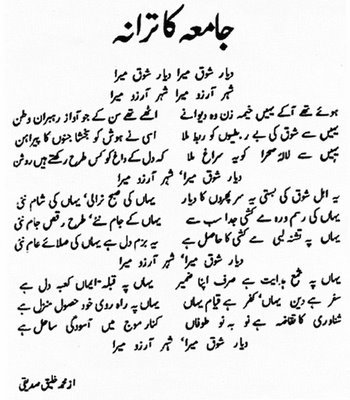
Jamia ka Tarana
Nov 7, 2007
Time out in campus-2 (1987-91)
The Curse of Being an Internal
Some doors you enter with hope. Others, you enter with a noose already around your neck, only you don't know it yet.
For many of us, entering the engineering faculty at Jamia Millia Islamia was that second kind of door. We didn't know it then, of course. We were young. We were eager. We had dreams in our eyes and fire in our bellies. We were ready to take on the challenges of life, ready to become engineers, ready to make our families proud.
But dreams, I have learned, are fragile things. They can survive poverty. They can survive struggle. But they cannot survive the slow poison of prejudice.
Those dreams were the first to evaporate. Not after the first semester. Not after the first few months. After just a few classes.
It was not because of the course contents or any difficulty to understand them. The equations, the diagrams, the theorems, we could grasp them all. We were not stupid. We were not lazy. We were not unprepared.
But there was something far more destructive than difficult subjects. It was the very bad behavior and biased attitude of many faculty lecturers who hailed from a particular institution. I will not name that institution. I don't need to. Those who know, know. Those who were there, remember.
They were openly against all internals for reasons unknown, with the exception of a handful of lecturers who still remembered what it meant to be a teacher. Reasons that were never explained. Reasons that had nothing to do with our merit, our work, or our potential. They had decided who we were before we even opened our mouths. And no amount of proof, no amount of performance, could change their minds.
This was the time when I experienced a totally new Jamia, although I was from the third batch after the commencement of B.Sc. Engineering course in 1984-85 by Prof. Ali Ashraf, the VC at that time. The Jamia I had known since childhood suddenly felt like a different place. It was still the same campus, the same buildings, the same corridors, but the people in power had changed. And they didn't want us there.
I had grown up in this campus. I had played in its grounds, studied in its schools, breathed its air. Jamia was not just an institution to me. It was home. It was identity. It was the soil that had raised me. But suddenly, it felt alien. Cold. Unwelcoming. We were pioneers in a way, the first ones to walk a new path. But pioneers, I discovered, are often the ones who bleed first.
It was a common practice of many lecturers to demoralize internals in the classroom, followed by an expulsion from the period. They would walk in, look at us with disdain, and before we could even open our notebooks, the taunting would begin.
Let me paint you a picture.
You walk into the classroom. You find your seat. You open your notebook. You wait.
The lecturer enters. He doesn't look at the class. He looks at you. Specifically you. The internal. The one from Jamia School. The one who doesn't belong.
And before you can even write the date on the top of the page, the taunting begins.
"Some of you think you deserve to be here," he says, not looking at anyone in particular, but looking at all of us. "Some of you think because you studied in Jamia School, you have a right to this seat. Let me remind you. You don't."
The words land like stones. You don't react. You can't. You just sit there, pen in hand, pretending to write, pretending it doesn't hurt.
Then comes the expulsion. "You. Out. I don't want to see your face today."
You gather your things. You walk out. The door closes behind you. And you stand in the corridor, alone, wondering what you did to deserve this.
The answer is simple. Nothing. You did nothing. You were just born on the wrong side of their prejudice.
There were exceptions though. Mr. Waqar, Mr. Masood Alam (Chemistry), Prof. Rafat (Physics), Mr. Afaq (English), and Mr. Idrees Qureshi (Maths) were really good. They acted like lecturers without any prejudice during my first year in 1987. They taught us, they guided us, they treated us like students. They were the reason some of us didn't give up. They were the reason some of us still believed that teaching was a noble profession. But they were few. The rest saw us as intruders.
One person who stood out was Prof. Mubeen. He was the Dean of the Faculty of Engineering, and he was indeed a fair person. He could judge people for who they were, not for where they came from. He understood problems instead of creating them. That was the reason why he was considered a good Dean. In a faculty filled with bias, he remained neutral. In a storm of hatred, he was the calm eye. He gave us hope when hope was in short supply.
But one man, no matter how fair, cannot fight an army.
And the army was relentless.
Whether it was Mr. Mehtab Alam, Mr. Shakeel, Mr. Gohar Mehmood, or anybody else, they were openly found discussing and disgracing JMI and the students coming from Jamia School. They would gather in the staff rooms, in the corridors, and talk about us as if we were a disease.
"You know these Jamia School types," they would say. "They are all the same. Bad students. Political bugs. Miscreants. Disturbing elements."
These were the labels they stuck on us. Without evidence. Without justification. Without even a single incident to back their claims. We were targeted. We were profiled. We were condemned. We were labeled as bad students, political bugs, miscreants, and disturbing elements by them, without even a single justification for their accusations.
The day started with taunting and ended in disgrace. There was no escape. Every morning we would brace ourselves, and every afternoon we would carry the weight of their words back to our home or hostel. The whole first year we spent in real misery and the same attitude was thoroughly reflected in the sessional marks given by them. The numbers on the grade sheets were not a reflection of our ability, but of their prejudice. A student who answered every question correctly would still get a passing mark at best. A student who showed up every day would still be marked absent in their hearts.
We were being graded not on our knowledge, but on our identity.
It was in the second year when we started to sustain their accusations. Something shifted inside us. We learned that the problem was never us. It was them. We stopped breaking. We started surviving.
And we never faced this kind of problem with external students. With them, we were just colleagues, just classmates, just part of the engineering faculty. The bias came only from those who had made it their mission to break us.
Mechanical, Civil, and Electrical were the only trades available during our times, with priority to Mechanical, then Civil, and then Electrical. Initially, I was allotted Mechanical, but I changed my discipline to Civil and registered as the first student rolled back to Civil from Mechanical. It was a small decision, but it felt significant. I was choosing my own path. I was refusing to be defined by their expectations.
There were many who adopted a policy to degrade internals in the classroom as their hidden agenda, but it was Mehtab Alam who came openly against us. He didn't hide his bias. He wore it like a badge. Mr. Shakeel from Hydraulics was no different.
I still remember when he literally abused one of my classmates. We were sitting in the classroom. The lecture was going on. And then, for no reason at all, Mehtab Alam turned on one of us. His words were not criticism. They were not correction. They were abuse. Pure, unfiltered abuse.
My classmate sat there, silent and dejected. The pain on his face was unbearable. You could see it in his eyes. You could feel it in the air. The humiliation was so thick you could touch it.
And I couldn't resist. Something inside me snapped. The pain inside me grew until it had to come out. I voiced against Mehtab Alam.
"Sir," I said, my voice shaking but my words steady. "You have no right to abuse anyone. You have no right to go personal."
He was surprised because it was the first time when he was opposed by someone. A student and particularly an internal. He stared at me. The room went silent. You could hear a pin drop.
He then emphasized on holding all of us for another six years in engineering. It was a threat. A promise of prolonged suffering. He wanted to break us. He wanted to make an example out of us.
I took his challenge and told him to go for it.
And he did.
He targeted most of the internals and me in sessional marks. The grades were cruel, but we had no choice except to wait and pray. Finally, the long-awaited results came out.
While taking the mark sheet from the office, he caught me along with his colleagues. Satirically, he asked me about my results. His smile was sharp. His eyes were mocking. He expected to see failure. He expected to see defeat.
I looked at him. I looked at his colleagues. And I bluntly told him that I got passed and he failed.
He didn't understand. Confusion replaced his arrogance.
I elaborated further. "Mr. Mehtab, you have tried with your associates to hold me in the second year by giving very bad grades in sessional. But it is Allah's grace that I performed well and the exam grades are far better than yours. Therefore, never try to abuse anybody with or without reason. You will lose the respect of a teacher."
The words hung in the air like a verdict. I walked away. But I didn't forget.
Despite all kinds of abuse heaped by those people, there were few who always acted like a teacher. One of them was Mr. Rasheed Ahmed in Environment. In the fresher's party arranged by second year students, he was the only one who openly spoke a few words in favor of Jamia internal students.
He mentioned, and I remember every word. "Please do not degrade internals in any specific way. They are no way inferior to any external in any regards. If we extend our trust on them, then we will find them performing better than anybody else in the college, not only in education but in other fields too."
This statement took all others by surprise, the ones who belonged to a particular institution and formed a sort of mafia in JMI. They didn't expect one of their own to break ranks. They didn't expect a voice of reason in their chorus of hatred.
But there were others who were not surprised. Mr. Khalid Moin, Mr. Nusrat Ullah Khan, Dr. Rafar, Mr. Waqar, Mr. Masood Alam, Dr. Idrees Qureshi, and Dr. Mubeen. They were the ones who had always been fair in their treatment to all students. They had always been teachers first.
Mr. Rasheed's statement was a cold breeze in the midst of a desert. After years of scorching heat, after years of parched souls, we felt a sigh of relief. We felt seen. We felt valued. We felt human. And we committed ourselves to perform better. Not for them. For ourselves. For Jamia. For the ones who believed in us.
It was one of the reasons that Engineering final year's results faded the faces of the mafia indulged in abusing internals. The toppers of Civil and Electrical in 1991 were from Jamia Senior Secondary School. The very internals they had tried so hard to break had risen to the top.
It was poetic justice. It was sweet revenge. But more than that, it was proof. Proof that we were never inferior. Proof that we only needed trust, not criticism. Proof that Jamia's own could shine brighter than anyone else.
It might be possible that all those names I mentioned above have become big bosses now. It might be possible that they have transformed themselves into unbiased entities now. People change. Or at least, they learn to hide their biases better.
But they should not forget that JMI is the only institution which enabled them to attain high positions in academics and in society. It gave them everything. A platform. A name. A future.
They must feel sorry for their behavior. Not for us. We survived. We thrived. We went on to build our own lives, our own careers, our own families.
They must feel sorry for themselves. For the teacher they could have been. For the respect they lost. For the legacy they tarnished.
As a person. And as a teacher.


Subscribe to:
Post Comments (Atom)
I do agree that General impression of all internals in Jamia in every department was like this. But to some extent internals were also responsible for that, reason being some of them were trouble makers only. But i am of the view that as all fingers are not equal, so lectureres treatment should have been case by case only.
ReplyDeleteThank you very much for visiting & leaving your comment here.
ReplyDeleteI do appreciate your feelings & agree with you.
What ever i have written there is purely based on incidents took place in 80's & it was common practice of listed lecturers to label all the internals with a wide brush.
Their negative attitude has worked for us but most of the time it works other way round.